Updated
How to Build a Supplier Scorecard (+ Free Template)
Learn how to build a supplier scorecard, what to measure, how to grade vendors, and download a free supplier scorecard template for Excel or Google Sheets.
Approving a supplier is one decision. Keeping them approved is the harder part.
Most businesses can point to the form, email, or meeting where a supplier was first approved. Fewer can answer the follow-up question with confidence: are they still performing well enough to stay approved?
That is where a supplier scorecard helps. It turns the half-remembered supplier story - "they're usually fine", "their paperwork is always late", "we had that quality issue last spring" - into something you can review, compare, and act on.
This guide walks through what to measure, how to weight and grade suppliers, what a good supplier scorecard example looks like, and how to use the result without turning the whole thing into audit-only paperwork. You can also download a free template and adapt it to your own supplier controls.
Download the template
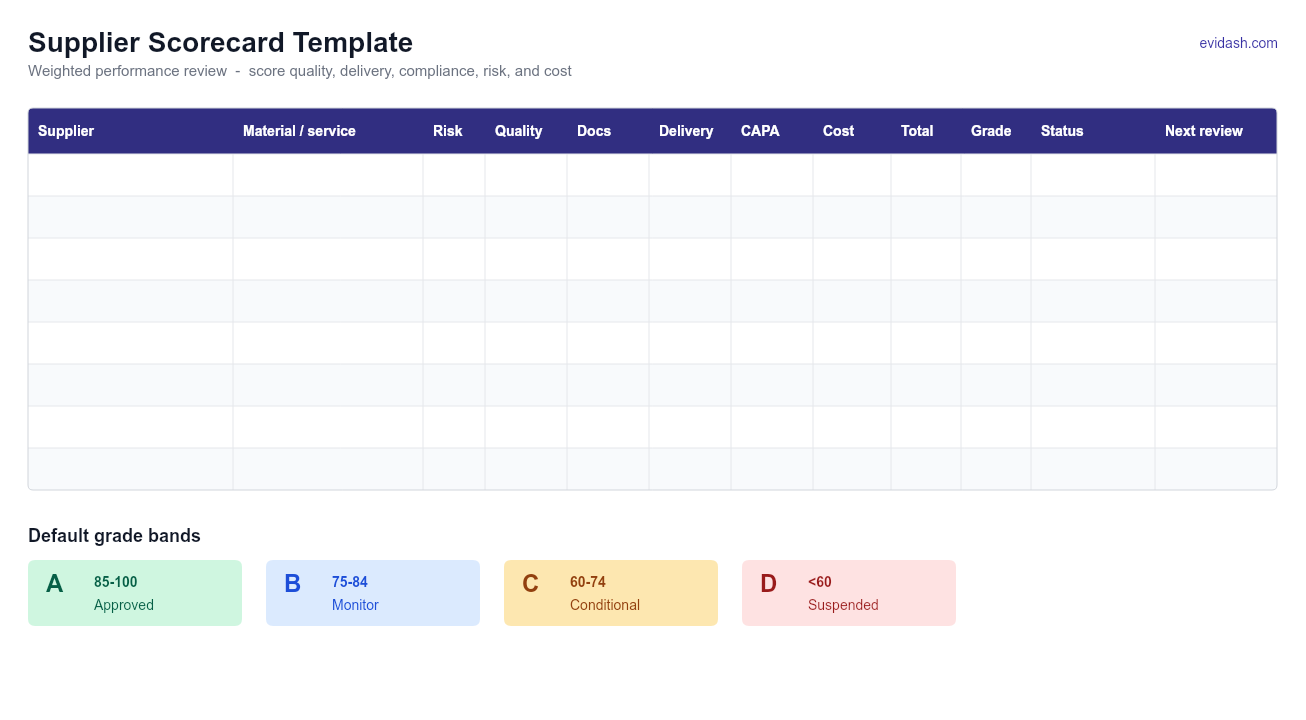
The Excel version is a working tracker with weighted scoring formulas, grade bands, and review fields. The PDF is a printable blank reference. If you just want a quick sample supplier scorecard layout before downloading anything, the full structure is also written out at the end of this guide.
What is a supplier scorecard?
A supplier scorecard, also called a vendor scorecard or supplier performance scorecard, is a structured way to rate a supplier's ongoing performance against agreed criteria. Instead of reviewing every supplier from memory, you score them on the same basis and revisit the score on a schedule.
It answers questions an approval decision alone cannot:
- Is this supplier still meeting our requirements?
- How does it compare with alternatives for the same material or service?
- Is performance improving, holding steady, or slipping?
- What should we do about it - keep, monitor, escalate, or replace?
The scorecard is the ongoing half of supplier control. Your approved supplier list records the decision to approve a supplier and what they are approved to supply. The scorecard records what happens after that. Approval gets a supplier onto the list; the scorecard helps decide whether they stay there.
Supplier scorecard vs vendor scorecard
These terms usually mean the same thing. "Supplier scorecard" is more common in manufacturing, food, and quality-management teams. "Vendor scorecard" is more common in procurement, finance, and services teams.
Whatever your team calls it - supplier scorecard, vendor scorecard, supplier performance scorecard, or supplier rating - the purpose is the same: to keep approval, performance, and risk connected. The best vendor scorecard examples are not complicated. They are clear enough that procurement, quality, and operations can all understand why a supplier got the grade they did.
Why a supplier scorecard matters
Your suppliers' performance eventually becomes your performance. A late delivery becomes your stockout. A defective component becomes your warranty claim. A lapsed certificate or insurance policy becomes your audit finding.
A scorecard matters because it catches those issues while there is still time to do something about them.
A working scorecard gives you:
- a single, comparable view of supplier performance across your supply base,
- early warning when a previously solid supplier starts to drift,
- objective evidence for approval, re-approval, and de-listing decisions,
- a defensible answer when an auditor or customer asks how you monitor suppliers,
- a better way to talk to suppliers about facts instead of vague frustration.
Without it, supplier performance is managed by memory and goodwill. That can work for a while. It stops working when the person who knows the history is away, a quietly declining supplier gets renewed on autopilot, or someone asks you to show - not just say - that active suppliers still meet requirements.
What a supplier scorecard should measure
A scorecard is only as useful as the metrics behind it. Too few categories and it tells you almost nothing. Too many and people stop filling it in. The categories below cover the areas that matter for most supply bases. Score each one on the same scale, such as 1-5 or 0-100, so the results can be weighted and combined.
Quality
- Defect, rejection, or return rate
- Out-of-specification or out-of-tolerance results
- Complaints attributable to the supplier
- Conformance to specification on each lot or batch
Why this matters: quality is the supplier's actual product performance, measured against your requirements rather than their promises. In manufacturing, food, and other quality-led environments, this is often the heaviest-weighted category.
Delivery and service
- On-time delivery
- In-full / order accuracy
- Lead-time reliability
- Responsiveness and communication
Why this matters: delivery and service issues are often the first visible sign that something is getting stretched. A supplier may miss dates or stop responding cleanly before quality starts to fail.
Cost and commercial
- Price stability and competitiveness
- Invoice and pricing accuracy
- Value-add, cost-down, or efficiency contributions
Why this matters: for commodity and indirect procurement, commercial performance is often a major lever. It still needs to be balanced against quality and risk. A cheap supplier who creates rework, delays, or audit exposure is not really cheap.
Compliance and documentation
- Required certifications valid and in date
- Insurance, licenses, and accreditations current
- Specifications current and approved
- Conformance evidence (such as Certificates of Analysis) supplied where required
- No overdue or expired evidence on file
Why this matters: this is the category many generic scorecards underweight, and it is often the one that turns into audit findings. A supplier that regularly lets documents lapse is giving you useful information about how they run their business. Expiry tracking is often where the first cracks show - see tracking certificate expiries and renewals and keeping supplier specs controlled.
Corrective action and risk responsiveness
- Time to acknowledge and close a supplier corrective action request (SCAR)
- Quality and depth of root-cause analysis
- Recurrence of previously raised issues
Why this matters: every supplier has problems eventually. The revealing part is how they respond. A supplier that owns the issue, finds the cause, and prevents recurrence is very different from one that sends a thin answer three weeks late.
How to weight and grade suppliers
Listing metrics is the easy part. The supplier scorecard becomes useful when you decide how much each category counts and what the final number means. The right weighting depends on your industry, your risk tolerance, and how critical the supplier is to your operation.
1. Weight by what actually carries risk
A safety-critical component supplier and an office-supplies vendor should not be scored on the same priorities. A defensible weighting for a quality- or compliance-driven supplier might look like this:
| Category | Example weight |
|---|---|
| Quality | 30% |
| Compliance and documentation | 25% |
| Delivery and service | 20% |
| Corrective action and risk | 15% |
| Cost and commercial | 10% |
For commodity or indirect procurement, you might raise cost and delivery and lower compliance. The key is to set the weights deliberately, and to set them before you score. Otherwise it is too easy to move the goalposts after seeing the result.
2. Score each category on a consistent scale
Use one scale across all categories, for example 0-100, or 1-5 converted to a percentage. Define what each level means so two reviewers would score the same supplier in roughly the same way. Vague scales produce scores that look objective but are really just opinions with numbers attached.
3. Combine into a weighted total
Multiply each category score by its weight and sum the result. That single weighted percentage is what makes suppliers comparable.
4. Convert the total into a grade and an action
A number on its own changes nothing. Map it to a band, and map each band to a defined response:
- A - Approved, performing. Continue at standard review frequency.
- B - Approved, monitor. Minor issues; note actions and watch at the next review.
- C - Conditional. Corrective actions required; increase review frequency; raise a SCAR.
- D - Suspended / under review. Hold or stop purchasing pending resolution or replacement.
The bands matter more than the exact cutoffs. The point is that a score should lead somewhere, so a declining supplier cannot quietly coast through another review cycle.
Supplier scorecard example
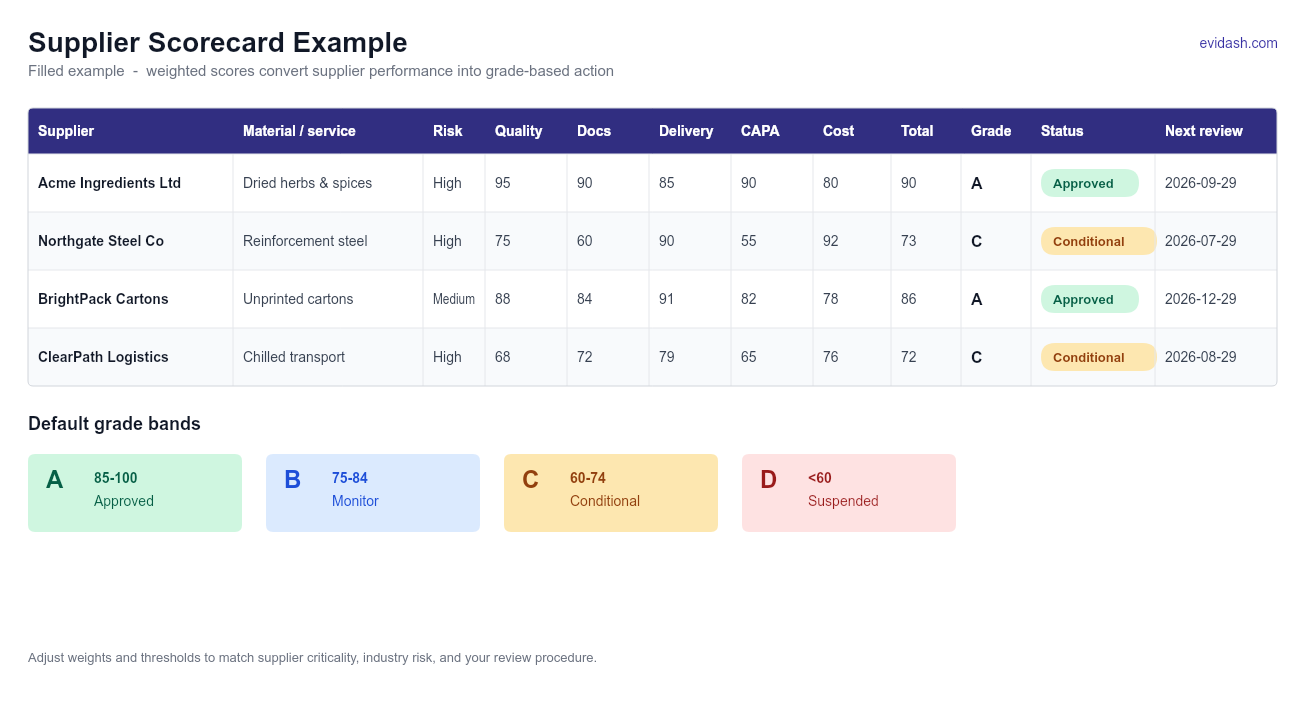
Here is a worked supplier scorecard example for two suppliers of the same component, scored 0-100 per category and weighted as above.
| Category (weight) | Supplier A | Supplier B |
|---|---|---|
| Quality (30%) | 95 | 75 |
| Compliance & documentation (25%) | 90 | 60 |
| Delivery & service (20%) | 85 | 90 |
| Corrective action & risk (15%) | 90 | 55 |
| Cost & commercial (10%) | 80 | 92 |
| Weighted total | 90 (Grade A) | 71 (Grade C) |
Both suppliers might feel acceptable day to day. Supplier B even delivers slightly better and costs less. But once the score is weighted toward quality and compliance, the risk is obvious: Supplier B is lapsing on documentation and slow to close corrective actions. That is exactly the sort of pattern people often sense before they can prove it.
This is why supplier scorecard examples are useful. They show how a vendor that looks fine in casual conversation can land in Grade C once the evidence is scored consistently.
Supplier scorecards by industry
The structure of a scorecard stays similar across industries. What changes is which categories carry the most weight and what evidence sits behind each score.
Regulated manufacturing and quality systems
Under ISO 9001 and similar quality systems, you need to control and periodically evaluate external providers based on their ability to meet requirements. Expect heavier weighting on quality, corrective action performance, and certification currency. Typical evidence might include defect rates, PPAP or first-article conformance, supplier audits, and re-approval records.
Food and beverage
Food safety schemes treat ongoing supplier monitoring as a core requirement because a supplier failure can become a product safety failure. BRCGS, SQF, and FSSC 22000 all expect risk-based approval and re-evaluation of active suppliers, and importers under FSVP must reassess foreign suppliers periodically. Compliance, certification, and COA conformance usually carry more weight here than cost. See the food supplier approval checklist, the SQF Edition 10 supplier-document gap checklist, the FSVP checklist, and Evidash's food and beverage solution.
Construction and trades
In construction, the scorecard often covers subcontractors and trade suppliers, so the emphasis shifts toward safety, insurance, and competence: public and employer's liability insurance in date, prequalification and accreditations such as CHAS, SafeContractor, or Constructionline, RAMS quality, and on-site performance. A lapsed insurance certificate against an active subcontractor is a classic avoidable finding. See Evidash's construction solution.
The common thread is simple: a scorecard is how you prove you are not just approving suppliers once and hoping nothing changes.
How to build a supplier scorecard
If you are starting from scratch, define the rules before you start scoring. A scorecard built supplier by supplier, without agreed criteria, quickly becomes a collection of opinions.
1. Define your categories and weights
Decide what you will measure and how much each category counts, based on risk and criticality. Write it down so every supplier is scored on the same basis.
2. Define the scoring scale
Set a single scale and describe what each level means. This is what keeps two reviewers broadly aligned and makes the scores easier to defend later.
3. Pull the data you already have
Much of the input already exists: quality and rejection logs, delivery performance, certificate and specification status, complaints, and open corrective actions. The scorecard should organize data you are mostly already collecting, not create a second job for everyone.
4. Score, weight, and grade
Score each category, apply the weights, calculate the weighted total, and convert it to a grade. The downloadable supplier scorecard template lays the columns out for this.
5. Tie grades to actions and review frequency
Map each grade to a response and a review cadence. Higher-risk and lower-grade suppliers should be reviewed more often.
6. Make it routine
A scorecard that gets rebuilt from scratch before each audit will always be a little out of date. The value comes from scoring on a schedule and acting on the trend.
How often to score suppliers
Scoring frequency should match risk and importance, not the calendar alone:
- High-risk or strategic suppliers (critical components, sole-source, regulated materials, history of issues): score frequently; quarterly is common, with certain quality metrics tracked per lot or delivery.
- Medium-risk suppliers: score on a defined cycle, often semi-annually.
- Low-risk suppliers (low-impact, easily substituted): annual scoring is usually enough.
Whatever the cycle, certain events should trigger an immediate re-score regardless of schedule: a failed or rejected lot, a recall or withdrawal, an expired certificate or insurance policy, a significant complaint, or a major corrective action.
Acting on the score
A scorecard that never changes a decision is just paperwork. The score should drive action:
- Keep and reward strong, stable suppliers, and consider consolidating volume toward them.
- Monitor suppliers with minor issues and confirm they are not trending downward.
- Raise a corrective action for suppliers that fall into the conditional band, with a clear owner, due date, and evidence of closure.
- Escalate or replace suppliers that stay low or keep repeating the same issues. A scorecard gives you the documented basis to do this defensibly.
The trend matters as much as the snapshot. A supplier sliding from A to B to C over three reviews is often more concerning than a one-off low score caused by a single isolated event.
Common supplier scorecard mistakes
Measuring only cost and delivery
Cost and on-time delivery are easy to pull from a system, so scorecards often over-index on them and underweight the quality, compliance, and risk categories that create the real exposure.
Scoring on opinion, not data
If two reviewers would score the same supplier very differently, the scale is too vague. Define what each level means and base it on records, not impressions.
A scorecard that never changes anything
If a poor score does not trigger a corrective action, a review, or a sourcing decision, the exercise is just paperwork with a nicer layout. Tie grades to defined actions.
Building it once, before the audit
A scorecard assembled the week before an audit reflects a moment, not a program. Score on a schedule so the trend is real.
Keeping the score disconnected from the evidence
When the scorecard lives in one spreadsheet and the certificates, specs, and corrective actions live somewhere else, the scores drift out of sync with reality. We cover why this happens in the risks of manual supplier document management.
From spreadsheet to system
A spreadsheet can hold a supplier scorecard, and an Excel or Google Sheets template is the right place to start. The hard part comes later: keeping the scores connected to the evidence underneath them - the certificates, specifications, conformance records, expiries, and corrective actions that the scores are supposed to reflect.
When the scorecard and the records are separate, you get the familiar problems: scores based on stale data, missed expiries that should have dropped a grade, and weak traceability when someone asks how a score was reached. That is usually where teams start looking for supplier scorecard software or vendor scorecard software. A better setup connects the score to the records behind it:
- one place to store supplier records, documents, and approval status,
- certificates, specifications, and conformance evidence linked to each supplier, with expiry visibility,
- corrective actions and review history tied to the supplier they belong to,
- scoring and review workflows with owners, status, and dates,
- an audit trail that shows what was reviewed, scored, and decided.
That is when a scorecard stops being a spreadsheet you rebuild before each audit and becomes a live view of supplier performance. For the wider picture, see our audit-ready supplier compliance framework.
Final thoughts
A supplier scorecard is not valuable because it produces a number. It is valuable because it turns supplier approval into something ongoing: a practical, comparable view of whether the suppliers you depend on are still meeting the requirements you approved them against.
If your scorecard cannot survive being compared with your certificates, specifications, conformance records, and corrective actions, it is not really measuring performance. It is recording opinions.
Evidash helps compliance-driven businesses keep supplier records, documents, specifications, and expiries in one place, link them to review and corrective-action history, and maintain a clear audit trail across approval and ongoing monitoring. Instead of rebuilding a supplier scorecard from scratch before every audit, teams can score from data that reflects the records underneath it.
If you are building or tightening your supplier scorecard, take a look at Evidash's supplier management software and expiry tracking to see how it can support ongoing supplier performance monitoring.
If you want to see the workflow before committing, explore the interactive demo.
Frequently asked questions
What is a supplier scorecard?
A supplier scorecard is a structured record that rates a supplier's ongoing performance against defined criteria such as quality, delivery and service, cost, compliance and documentation, and responsiveness to corrective actions. Where an approved supplier list captures the decision to approve a supplier, the scorecard tracks whether that supplier keeps performing after approval.
Is a supplier scorecard the same as a vendor scorecard?
In practice, yes. "Supplier scorecard" is more common in manufacturing, food, and quality teams, while "vendor scorecard" is more common in procurement and finance. Both describe the same control: a repeatable way to score and compare the organizations you buy from so that approval, performance, and risk stay connected.
What metrics should a supplier scorecard include?
Common categories are quality, delivery and service, cost and commercial performance, compliance and documentation, and corrective action responsiveness. In regulated industries, compliance and documentation carry more weight; in commodity procurement, cost and delivery often dominate. Each category is scored, weighted by importance, and combined into an overall grade.
How often should suppliers be scored?
Scoring frequency should match risk and importance. High-risk or strategic suppliers are typically scored quarterly, while low-risk suppliers may be scored annually. Beyond the schedule, events such as a failed lot, a recall, an expired certificate, or a major complaint should trigger an immediate re-score.
What is a good supplier scorecard score?
There is no universal pass mark; you set banding that reflects your risk appetite. A common approach is to grade suppliers into tiers, for example A for approved and performing well, B for approved with monitoring, C for conditional with corrective actions required, and D for suspended or under review. What matters is that the bands are defined in advance and tied to clear actions.
How do you calculate a weighted supplier scorecard?
Convert each metric to the same scoring scale, multiply each score by its weight, and add the results. For example, quality at 80 with a 50% weight, delivery at 90 with a 30% weight, and documentation at 70 with a 20% weight gives an overall score of 81 out of 100. Weights must total 100%, and the scoring rules should define how missing data is handled. Keep mandatory compliance failures separate so a high average cannot override a failed approval requirement.
How do I create a supplier scorecard in Excel?
Create columns for supplier, review period, metric, target, actual result, normalized score, weight, and weighted score. Use SUMPRODUCT on the normalized scores and percentage weights to calculate the total, with weights adding up to 100%. Keep links to supporting evidence, explain the scoring thresholds, and add an action owner and due date for poor results. Compare suppliers using equivalent scopes, periods, and scoring rules.
Supplier scorecard template
Use this sample supplier scorecard as a starting point and adapt the categories, weights, and bands to your industry, risk profile, and audit requirements. Each row is one supplier and material or service.
Supplier identification
- Supplier name
- Supplier ID or vendor code
- Material or service scored
- Risk tier (high, medium, low)
Scoring categories (score each on one scale, e.g. 0-100)
- Quality (suggested weight 30%)
- Compliance and documentation (25%)
- Delivery and service (20%)
- Corrective action and risk (15%)
- Cost and commercial (10%)
Result
- Weighted total score
- Grade (A, B, C, D)
- Status (approved, monitor, conditional, suspended)
Review and actions
- Reviewer
- Review date
- Next review date
- Outstanding corrective actions
- Performance and trend notes
See Evidash on your own documents
Put supplier certificates, specs, and COAs through the same audit-ready workflow you just read about.