Published
BRCGS Supplier Document Control Checklist (+ Free Template)
Download a BRCGS supplier document control checklist for approval evidence, specifications, certificates, expiry tracking, review history, and audit retrieval.
BRCGS audit readiness depends on operational evidence: current supplier approvals, controlled specifications, traceable reviews, timely follow-up, and records that can be retrieved without rebuilding the story from emails and folders.
Many people still search for “BRC compliance,” but the current brand and standards are BRCGS. This checklist uses BRCGS terminology while covering the supplier-document controls behind that common search intent.
Download the BRCGS supplier document control checklist
Use it as an operational gap review. It does not replace the applicable BRCGS standard, interpretation guidance, your certification body, or qualified food-safety judgment.
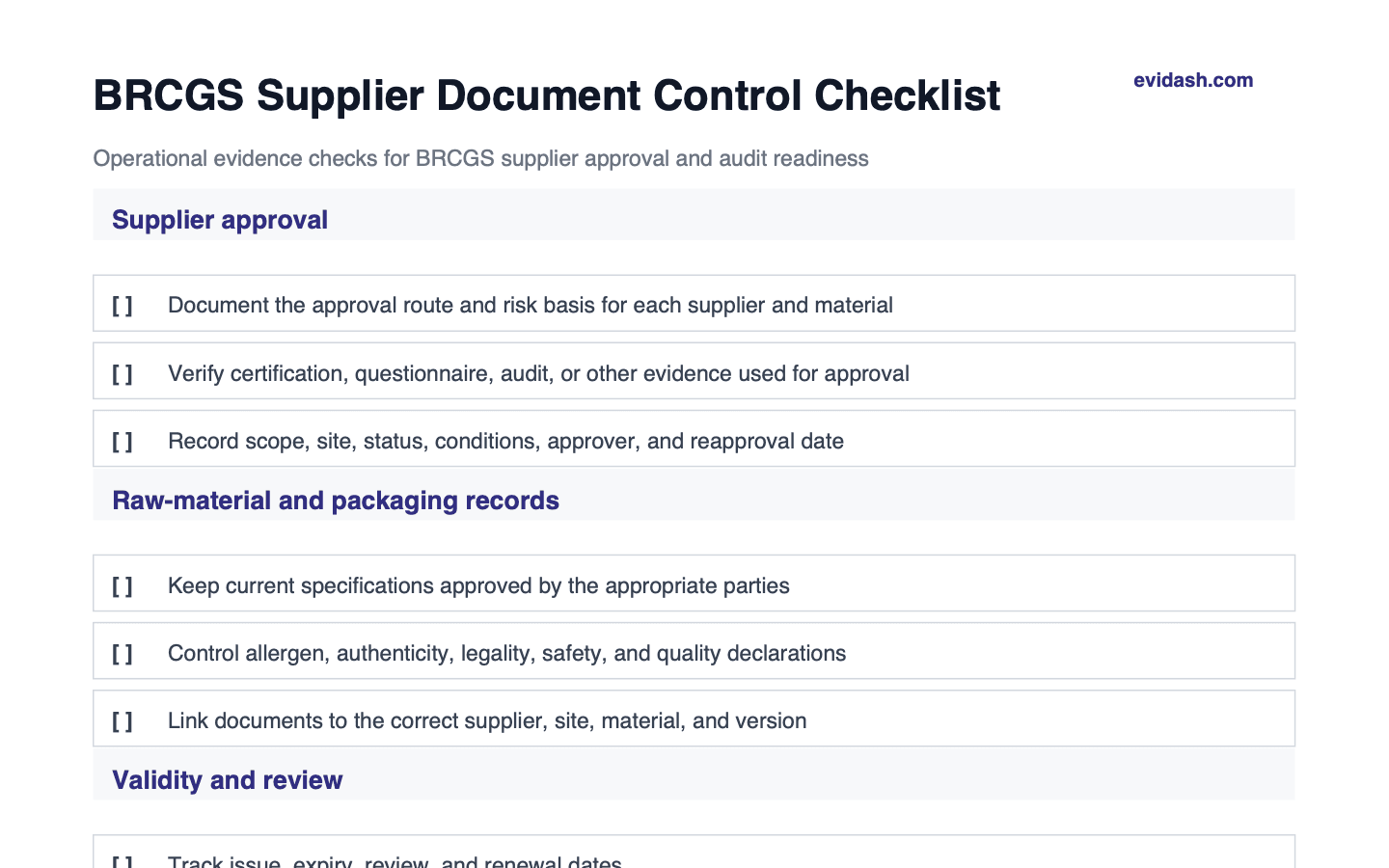 More checks in the full PDF
 What this BRCGS checklist covers
The checklist focuses on the supplier and record-dependent workflows Evidash supports:
- supplier and raw-material approval evidence,
- specifications and declarations,
- certification and document validity,
- review and approval history,
- missing and expiring evidence,
- supplier monitoring and change,
- rapid audit retrieval.
It is not a complete BRCGS site-audit checklist. Facility, HACCP, hygiene, process, product, culture, internal-audit, and management-system controls require their own assessment.
1. Connect supplier approval to risk and scope
For every supplier and relevant raw material or service, be able to show:
- the approved legal entity and site,
- exactly what is approved,
- the risk basis and selected approval route,
- evidence used in the decision,
- approver, date, status, conditions, and review frequency,
- what would trigger reassessment.
A supplier name on an approved list is not enough if the business cannot show the site, material, basis, and current evidence behind the decision. The food supplier approval checklist provides the broader decision structure.
The resulting decision should remain visible in a controlled approved supplier list, with the approval basis, scope, conditions, evidence status, and next review connected.
2. Control specifications and supporting declarations
Specifications should be current, approved, correctly scoped, and easy to retrieve. Check:
- supplier, site, product, material, and market applicability,
- revision, effective date, approval status, and change history,
- food safety, legality, quality, allergen, authenticity, and labeling information,
- alignment with declarations and supporting evidence,
- communication and reapproval after changes.
A controlled specification management system should make the approved revision explicit and preserve the history behind it.
3. Review certificates rather than only collecting them
For each certification record, verify:
- supplier legal name and manufacturing site,
- scheme, grade, category, scope, and exclusions,
- certification body and accreditation details where relevant,
- audit, issue, and expiry dates,
- open conditions or significant findings,
- fit with the supplier-approval requirement.
Use the supplier document review checklist to apply the same identity, scope, validity, decision, and traceability controls across other evidence types.
4. Make expiry and missing evidence visible
Record issue, expiry, review, renewal, and next-action dates. Define statuses that separate:
- current,
- approaching expiry,
- renewal requested,
- expired,
- missing,
- rejected,
- superseded,
- awaiting human review.
Set reminder, escalation, and approval-impact rules. A dashboard should let QA see exceptions before audit preparation begins. Evidash certificate expiry tracking software is designed for this operating view.
5. Preserve review and decision history
For every material review, keep:
- the submitted file,
- requirement and specification version used,
- extracted or captured values,
- reviewer and timestamp,
- accepted, conditional, rejected, or needs-review decision,
- rationale and highlighted evidence,
- corrections, follow-up, and replacement history.
Automation can reduce data entry and flag likely gaps, but the responsible reviewer should retain control of the final QA decision.
6. Monitor supplier performance and change
Supplier control continues after approval. Connect complaints, nonconformances, incidents, audit findings, late renewals, specification changes, ownership changes, site changes, and certification changes to reassessment.
Record:
- trigger event,
- risk impact,
- required action,
- approval impact,
- owner and due date,
- closure evidence.
A supplier scorecard can structure ongoing performance, while the supplier record preserves the supporting evidence.
7. Test audit retrieval before the audit
Select representative suppliers and ask the team to retrieve:
- the current approval and scope,
- the risk basis,
- current certificate and specification,
- latest review decision,
- open exception or renewal,
- historical record showing what changed.
If the answer requires several people, inbox searches, or an offline reconstruction, the records are stored but not yet audit ready.
Common BRCGS supplier-document gaps
- Approval evidence covers a different site or product category
- Certificates are current but not reviewed for scope
- Specifications have no clear approved revision
- Expiry dates are captured but do not generate action
- Replacement documents overwrite history
- Supplier changes do not trigger reassessment
- AI or automation outputs have no accountable final reviewer
- Audit packs are assembled manually from disconnected records
Use software as the control layer, not the standard
Software does not make an organization BRCGS compliant or certified. It can make supplier-document workflows more reliable by centralizing records, controlling versions, tracking validity, routing review, and preserving evidence.
See how Evidash supports these workflows on the BRCGS compliance software page, or start with the broader 90-day supplier compliance program.
Frequently asked questions
Is BRC the same as BRCGS?
BRCGS is the current brand name. “BRC” remains a common shorthand and search term, but teams should use the current applicable BRCGS standard and materials when defining requirements.
Does BRCGS require supplier approval records?
BRCGS food-safety programs include risk-based controls for suppliers and raw materials. The precise requirements depend on the applicable standard and issue, so organizations should verify them against their licensed standard and certification guidance.
Can BRCGS compliance software replace certification work?
No. Software can support document, approval, expiry, review, and evidence workflows. The organization remains responsible for its food-safety management system, implementation, internal verification, and certification process.
See Evidash on your own documents
Put supplier certificates, specs, and COAs through the same audit-ready workflow you just read about.